Computing Power Fuels the Glorious Moments of "Robot‑Athletes"|NeuroCub Platform Competes at the 2nd World Humanoid Robot Games
As 100‑meter sprints shatter human‑level records and high‑jump leaps push performance boundaries, the 2nd World Humanoid Robot Games staged a summit showdown of embodied intelligence’s speed and power at the National Speed Skating Oval (“Ice Ribbon”). Numerous domestic humanoid robot teams took to the field, with multiple flagship models delivering standout performances across dozens of events including track‑and‑field races, jump challenges and complex‑scenario operations. As the core brain computing platform powering many competing star robots, Realtimes NeuroCub Platform underwent rigorous real‑world validation under extreme on‑site conditions, underpinning the underlying computing foundation for embodied intelligence.
This edition of the World Humanoid Robot Games brought together over a thousand robots worldwide competing in 51 events. Competitions comprehensively evaluated robots’ overall capabilities: locomotion, environmental perception, real‑time decision‑making and fully autonomous operation. Many Chinese humanoid robot teams fielded flagship units for more than 40 contests spanning high‑speed track‑and‑field, strength challenges, dexterous manipulation and real‑world scenario simulation.
Race‑track prototypes stole the spotlight, competing in track events including 100 m, 400 m and 1500 m sprints as well as high jump. A remarkable 9.39‑second result was achieved in the 100‑meter preliminary heat, while the high‑jump reached 2.8843 meters, setting successive new competition records and drawing wide acclaim. The robots operated fully autonomously throughout, with no reliance on track marking lines. Multi‑view vision perception enabled lane recognition, path planning, acceleration and braking. While running at high speed, gait balance was dynamically adjusted to execute complete high‑difficulty motion sequences: starting, accelerating, sprinting, leaping and stable landing.


Beyond high‑speed track‑and‑field events, power‑oriented prototypes competed in strength‑based contests such as weightlifting, tug‑of‑war and emergency rescue. Task‑focused prototypes took on real‑world missions in shopping mall, office and household scenarios to validate practical capabilities including environmental understanding, human‑robot interaction and bimanual manipulation. Multi‑robot collaborative competitions fully demonstrated the comprehensive technical strength of domestic humanoid robots.
Every steady run and soaring leap on the robot arena is not merely the output of joint mechanical power, but the outcome of massive real‑time data processing and millisecond‑level decision‑making from the robot “brain”. In high‑speed locomotion scenarios, humanoid robots need to simultaneously process massive sensor data from multi‑channel cameras, LiDAR, inertial navigation and joint feedback. They run algorithms for sensor fusion, motion planning and large‑model inference, while enabling high‑speed real‑time interaction between the brain‑level and cerebellum‑like motion control systems. This places extremely stringent demands on the computing platform in terms of peak computing performance, complete interface options, real‑time synchronization capability and stability under vibration conditions.
Realtimes NeuroCub Platform served as the core brain computing unit for multiple key humanoid robots participating in the games, undertaking core responsibilities for system‑level perception, environmental understanding, AI inference and task decision‑making. Built on the Jetson architecture, the platform delivers scalable AI computing output. It supports smooth on‑device computation of complex models including multimodal perception, world models and motion‑policy inference, delivering sufficient computing guarantees for environmental perception and gait planning during high‑speed running and jumping maneuvers.
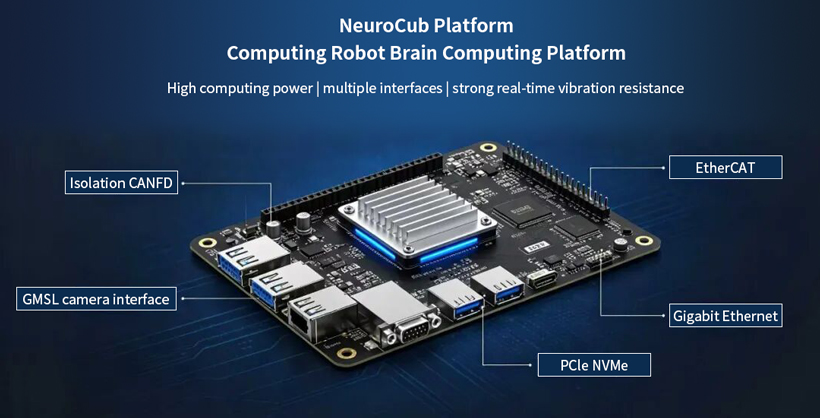
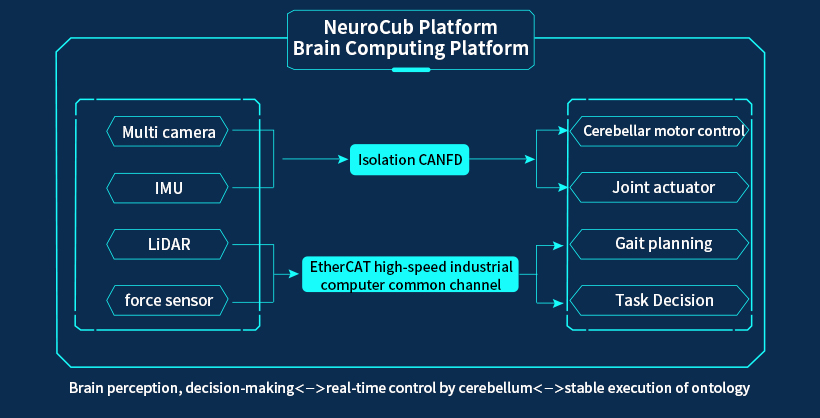
【The image above illustrates the working principle of the NeuroCub Platform】
Targeting the mainstream "brain‑cerebellum split" architecture for humanoid robots, the NeuroCub Platform natively integrates CAN FD and is compatible with high‑speed EtherCAT industrial bus. It enables low‑latency communication between the brain computing unit and low‑level joint cerebellum controllers, ensuring motion command issuance and joint status feedback at up to tens of thousands of cycles per second. Even under severe vibration caused by high‑speed running during competitions, it maintains stable and reliable communication and avoids command anomalies induced by electromagnetic interference.
In terms of hardware interfaces, the platform is equipped with multi‑channel GMSL high‑speed camera interfaces to support synchronous acquisition for multi‑view vision. Nanosecond‑level time synchronization aligns timestamps across multiple sensors. This allows prototypes to accurately identify track boundaries and obstacles and complete fully‑autonomous races without relying on track marking lines. Its compact industrial design fits the confined internal space of humanoid robots, balancing computing performance, rich interfaces and overall lightweight requirements. Validated through extensive prototype tuning and real‑world testing under extreme conditions, the platform withstands continuous high‑load pressure from intense tournament competitions and delivers consistent computing performance.
From lab‑based simulation to extreme real‑world tournament challenges, the World Humanoid Robot Games acts both as an arena for humanoid robots and a proving ground for computing hardware. The outstanding achievements of competing prototypes stem from collaborative innovation among robot hardware, motion algorithms and underlying computing platforms. Validated through real‑world competition trials, the NeuroCub Platform fully demonstrates that domestic embodied‑intelligence computing platforms are fully capable of meeting full‑lifecycle hardware requirements for humanoid robots, including prototype R&D, prototype testing, data collection & training, competition validation and subsequent commercial deployment.
Going forward, Realtimes will further deepen its efforts in edge computing for humanoid robots. It will iterate and optimize the NeuroCub Platform product series, build an open and comprehensive hardware ecosystem, and cooperate with upstream and downstream industry partners. With robust underlying computing infrastructure, Realtimes will help more humanoid robots move beyond competition arenas toward industrial adoption and real‑life application scenarios.
【Note】Part of the on‑site competition photos quoted in this article are sourced from public news media. Copyright belongs to the original right‑holders and the materials are used solely for event illustration.
official website:www.realtimes.cn
www.realtimesai.com
Service Hotline:400-100-8358
Contact email: sales@realtimes.cn
Address: 11th Floor, Building B, No. 20 Heping West Street, Heping West Garden, Chaoyang District, Beijing
 ∷
∷